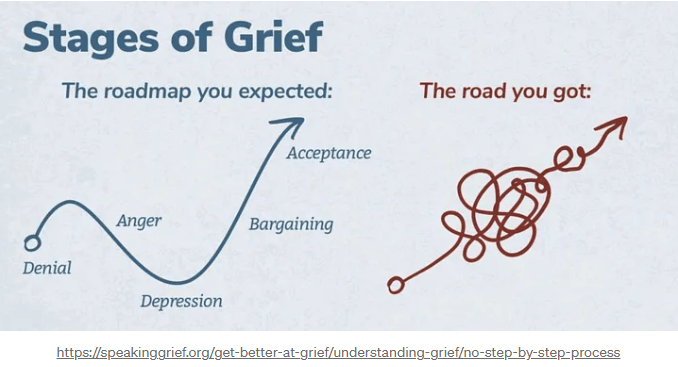
I heard of the “5 Stages of Grief” growing up, so naturally, those stages came to my mind after Charles’ death. I had been taught that the stages of grief are a linear and logical path to healing, a path to returning to “normal”. It did not take long for me to learn grief is not something we should count on to take us through a specific sequence of steps to heal or to get back to normal. I learned very quickly that grief is an exhausting heaviness to be carried in every step, not in any logical or linear progression with any of those steps.
I was curious about the 5 Stages of Grief and how they came to be such a big part of people’s thoughts on how to deal with grief. How did these steps shape the minds and beliefs of dealing with grief and loss in our society? These stages of grief were first published by a Swiss-American psychiatrist named Elisabeth Kubler-Ross in her 1969 book named “On Death and Dying”. She found these stages of grief through studying and spending time with terminally ill patients. These stages of grief were not designed for those experiencing bereavement, rather those facing their own death. A few years ago, Kubler-Ross discussed how these stages of grief should not have been presented as a linear progression.
My story had grief encompass me on a fateful night a couple of years ago, my mind being filled with unreal expectations of some linear movement, some logical movement through this process to heal and be back to normal. I thought the journey along the logical progression of these steps gave me a goal of grieving to get to the acceptance phase, which meant returning to a familiar normal. Oh, how I wish I would have been exposed to the raw truth about grief and loss, which is the jumbled mess of grief and loss that has been my life for over 2 and a half years. Knowing the illogical and circuitous route grief takes us would not have emotionally prepared me to face each day carrying the loss of my son. However, I do believe having a knowledge that this journey of loss can turn any which way at any time could have helped me to not spend precious energy questioning myself and my grieving as much as I did. There were times I felt I must be doing something wrong by not making continual, linear progress to healing.
I now am convinced that there is no normal path to recovery from loss. There is no getting back to normal. The life after loss is a heavy, complicated, and multi-layered journey that has swings from one extreme to the other (sometimes multiple swings and multiple extremes at the same time). There are times when the weight seems to be gone, times of laughter, times of relief, times of enjoyment. There are times when the weight is heavier than ever, where I wonder if the sun will come up tomorrow. Then there are times in the middle where it seems life is just moving along, neither heavy nor light. Thankfully, the times of supreme heaviness seem to be coming at longer and longer intervals (until the aren’t).
What has learning of this jumbled mess we call grief or loss taught me? There is no place you should be, there is no right or wrong direction to be moving, there is no logic to any of your steps of grief. No one can tell you how your journey of grief should be going. No one can tell you how you should react differently, when in a moment of heaviness you don’t have anything to give to another. There is no road map to dealing with loss. There is only YOUR journey. Learning the craziness of loss deep down in my heart has released much of the stress, in my mind, of wondering if I am doing it right. It has released me from thinking I should be making more progress or progress in a different way. It has allowed me to rest in the fact that it is okay to not be okay. Knowing grief is not a logical or linear progression has allowed me to use more energy loving my family and missing my Charles, instead of wondering if I should be doing things differently. For me, that is how we progress through our jumbled mess of these stages through which grief takes us, we know to just take the next step (no matter which direction that next step is taking us).
Tim
 Every Step with Grief
Leave a comment